Fire safety in care homes is one of those things that can feel straightforward until you stop and think about what an actual emergency would look like.
What happens when the alarm goes off at 3 am?
One resident cannot get out of bed without help. Another is confused and does not understand why everyone is suddenly leaving. Someone else uses a wheelchair. Your night team is smaller than it is during the day. And the quickest route out of the building is no longer available.
That is when you find out whether your fire safety arrangements actually work.
Fire safety in care homes is not simply about having the right equipment or completing the right paperwork. It is about understanding the risks in your building, knowing the people who may need additional support and making sure your staff can respond safely when something goes wrong.
You may have a fire risk assessment. You may have evacuation plans. You may have records showing that your alarm has been tested and staff have attended training.
But when did you last ask whether those arrangements still reflect the people living in your service today?
What happens if a resident's mobility changes? What happens if your night staffing levels are different from your daytime staffing? What happens if a fire door is found not to be closing properly and the issue stays on an action plan for weeks?
Take a walk through your service and ask yourself:
If the fire alarm went off tonight, would the staff on shift know exactly what to do?
If you cannot confidently answer those questions, then this guide will look at the key areas of fire safety in care homes, including fire risk assessments, evacuation planning, fire safety systems, staff training, and what CQC may look for during an inspection.
Legal Responsibility of Fire Safety in Care Homes
So, what should good fire safety in care homes actually look like?
The first thing to understand is who is responsible.
Fire safety in care homes is governed primarily by the Regulatory Reform (Fire Safety) Order 2005, usually shortened to the Fire Safety Order. It applies to all non-domestic premises in England and Wales, care homes included, and places the core legal duty on what it calls the responsible person.
In a care home, that's typically the registered provider or manager — whoever has control of the premises. They're legally accountable for identifying fire hazards, assessing risk and putting proportionate measures in place to protect everyone on site: residents, staff and visitors.
The responsible person can delegate the practical work. They cannot delegate the liability.
It's also worth knowing that enforcement doesn't sit with CQC alone. Local Fire and Rescue Services enforce the Order directly, carrying out inspections routinely or in response to concerns, with powers to issue enforcement notices or prohibit the use of a building entirely. A serious failing found by one regulator is very likely to become a concern for the other.
Did You Know?
CQC's registration guidance asks care home applicants to submit a current fire risk assessment covering identified hazards, protective measures, and plans to support people who need help to evacuate, including personal emergency evacuation plans (PEEPs).
Fire safety is now a registration gateway, not just an inspection topic.
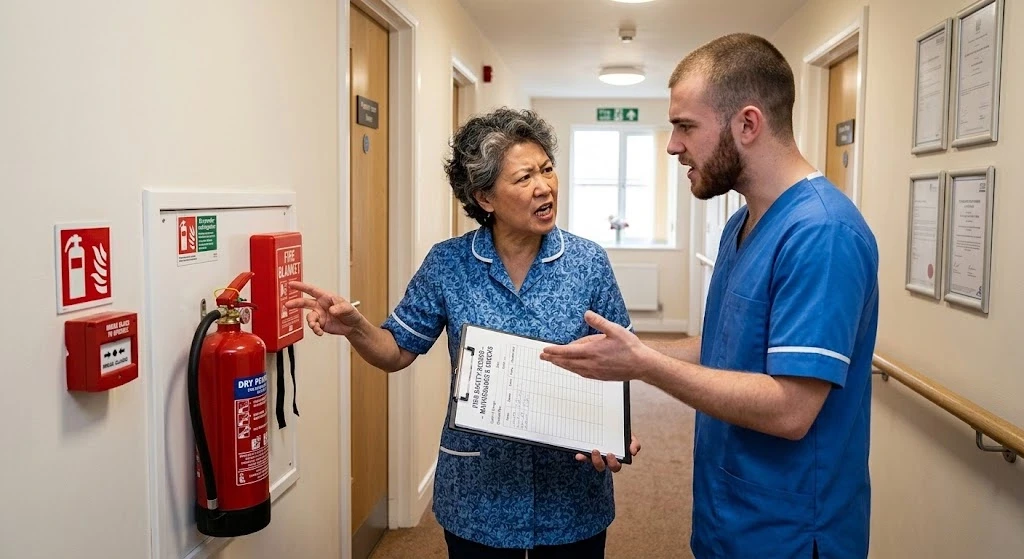
Fire Safety Evacuation Steps in Care Homes
When a fire alarm sounds in a care home, staff cannot afford to stop and work out what to do next.
The evacuation procedure needs to be clear enough that everyone on shift understands their role, knows which residents they are responsible for, and can act without unnecessary delay.
A good evacuation plan should answer a simple question:
If a fire started right now, what happens next?
Here is what that process should look like.
Step 1: Raise the Alarm and Alert the Fire Service
The priority is to make sure everyone knows there is a fire or suspected fire.
Staff should follow the home's fire procedure for raising the alarm and ensure the fire and rescue service is contacted promptly. The exact responsibilities should already be clear rather than being decided during the emergency.
Step 2: Follow Each Resident's Evacuation Plan
Once the alarm has been raised, staff need to begin moving people to safety according to the home's evacuation plan.
This is where Personal Emergency Evacuation Plans (PEEPs) become important.
A PEEP sets out the assistance an individual may need to evacuate safely. Depending on the person's circumstances, this could include the number of staff required, the equipment needed, the route to be used, and any particular communication or mobility considerations.
The important thing is that staff must actually know what the plan says.
Step 3: Move Residents to the Planned Escape Routes
Evacuation does not simply mean getting people out of their bedrooms. Staff should follow the evacuation routes identified in the fire safety arrangements rather than improvising.
That means escape routes need to be:
- Clearly identified
- Kept free from obstruction
- Suitable for the people who may need to use them
- Supported by appropriate fire safety measures
- Included in evacuation drills and staff training
There should also be a contingency if the usual route is blocked.
This is particularly important in a care home because the safest route for one resident may not be the safest or most practical route for another.
Step 4: Account for Everyone
Once residents and staff have been moved to a place of safety, the service needs to establish who has been evacuated and whether anyone may still be inside.
This is another reason accurate records matter.
Staff need to know who is in the building, where residents are normally located, and which residents require additional assistance.
Visitors and other people on the premises also need to be considered.
The aim is not simply to get outside. It is to know that everyone who may have been exposed to the fire has been accounted for and to give the fire and rescue service accurate information when they arrive.
Step 5: Review What Happened Afterwards
The evacuation does not end when the immediate emergency is over.
Whether it was a real incident or a drill, the service should look at what happened and identify anything that needs to change.
- Did staff know their roles?
- Did everyone evacuate as expected?
- Did a resident's PEEP work in practice?
- Was the evacuation equipment available and suitable?
- Did staffing levels create a problem?
Was there confusion over who was responsible for contacting the fire service?
These questions are important because a drill is only useful if you learn from it.
Compliance Tip
There can be a temptation during an emergency to try to do everything.
Staff may want to go back for a resident, tackle a fire themselves, or retrieve equipment.
It’s important to follow the home's emergency procedure and protect residents without putting themselves at unnecessary risk.
What CQC Looks for in Care Homes Fire Safety
A fire risk assessment is not simply a document to keep in a compliance folder.
CQC does not simply want to see evidence that a care home has a fire policy.
CQC has previously stated that it assesses fire safety in care homes during registration and inspection, including both active and passive fire protection and how fire safety is managed day-to-day.
So, when looking at your fire safety arrangements, think beyond whether the documents exist.
That means the assessment needs to look beyond obvious fire hazards.
Depending on the service, this can include:
- Sources of ignition: Electrical equipment, cooking facilities, laundry equipment, smoking and other potential ignition sources.
- Sources of fuel: Furniture, bedding, waste, laundry and other combustible materials.
- People at risk: Including residents who may have difficulty recognising danger, moving independently or responding to an alarm.
- Escape routes: Whether residents and staff can reach a place of safety using the available routes.
- Fire detection and alarm systems: Whether the system is suitable, maintained and regularly tested.
- Emergency lighting: Whether escape routes remain adequately visible if normal lighting fails.
- Fire doors and compartmentation: Whether they are maintained and able to perform their intended function.
- Evacuation arrangements: Whether the planned approach reflects the needs of the people living in the home and the staffing available.
- Smoking arrangements: Where smoking takes place, including safe controls around ignition sources and disposal of smoking materials.
- Actions arising from the assessment: What needs to be done, who is responsible, and when it should be completed.
The important part is that the assessment reflects your care home.
The evidence needs to show that fire safety is actively managed, not simply documented.
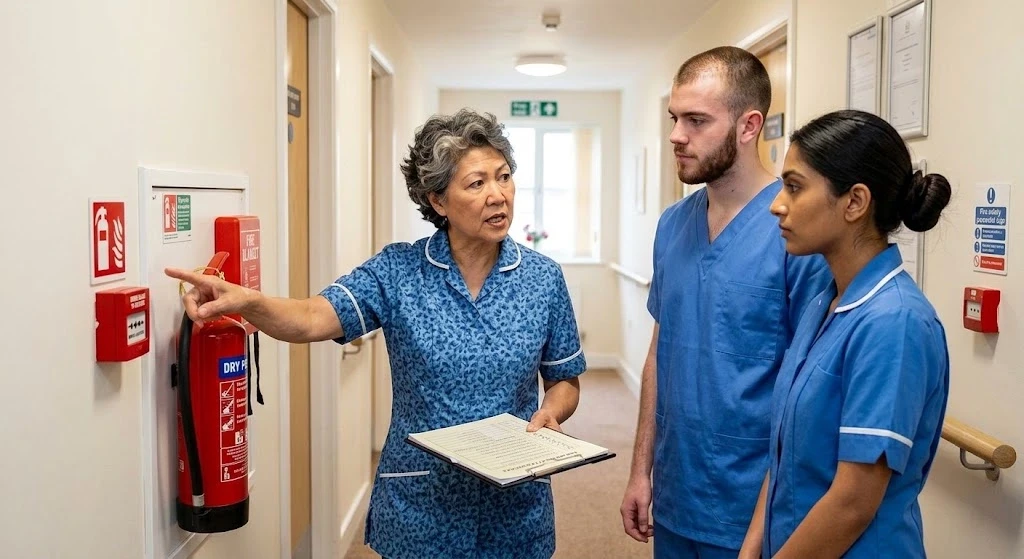
Common Fire Safety Mistakes to Avoid
Most fire safety problems do not begin with a major failure.
They usually start with something small that is overlooked, postponed, or assumed to be someone else's responsibility.
Some of the common issues care providers should watch for include:
- Outdated fire risk assessments that no longer reflect the building or people living there
- PEEPs that have not been reviewed after a resident's needs change
- Staff who know the procedure on paper but have not practised it
- Fire doors being wedged open or not closing properly
- Escape routes becoming obstructed by equipment, furniture or storage
- Fire safety checks being completed without following up on defects
- Drills being carried out only in easy daytime conditions
- Night staff not being adequately prepared for evacuation responsibilities
- Action plans with no clear owner or completion date
- Poor records that make it difficult to demonstrate what was checked, when it was checked, and what happened afterwards
One of the biggest mistakes is treating fire safety as a collection of individual tasks.
Strengthen Your Fire Safety Practice Today
Fire safety in care homes isn't a box-ticking exercise. It's one of the clearest tests of whether a service's systems genuinely protect the people living there.
That means acting when a problem is identified rather than allowing it to become another item on an action plan.
Get the risk assessment specific, the PEEPs current, the records evidenced, and the drills realistic, and you move from paper compliance to actual safety.
Need more CQC-compliant support?
👉 Download our free Care-Compliant Guides and Templates
👉 Invest in Accredited CQC-compliant Adult Social Care Qualifications
👉 Advertise and apply for care sector job listings on Care Wizard for FREE