Heatwaves are not new. But the harm they cause in care settings is still being underestimated. The summer of 2022 left a mark on the UK care sector that nobody who worked through it will quickly forget.
Over 3,000 excess deaths were recorded during the heat events that July, with older people and care home residents bearing the heaviest toll. Two years on, the UK Health Security Agency's Heat-Health Alert system has been updated, the guidance is clearer, and the expectations on providers are higher.
But guidance does not keep a resident hydrated. People do. Care workers who safeguard residents during a heatwave are not just tasked with a seasonal compliance box to tick; it is one of the most direct ways front-line staff prevent serious and sometimes fatal harm to the people in their care.
A question that comes up often in training sessions captures exactly where the uncertainty tends to sit:
"My resident kept saying she was not thirsty, even when the temperature was 32°C. I encouraged fluids, but I was not sure how hard to push or when to escalate. I just did not want to get it wrong." ~ Ariel Eriana (Senior Care Worker, Essex)
The problem is that heatwave risk is still underestimated in care settings, and care workers often do not feel equipped with the specific, practical steps that make the difference.
That uncertainty is exactly what this guide is here to fix. Here is a practical, step-by-step guide for care workers on how to safeguard residents during a heatwave, from identifying who is most at risk before the temperature even rises, to knowing the exact moment you pick up the phone.
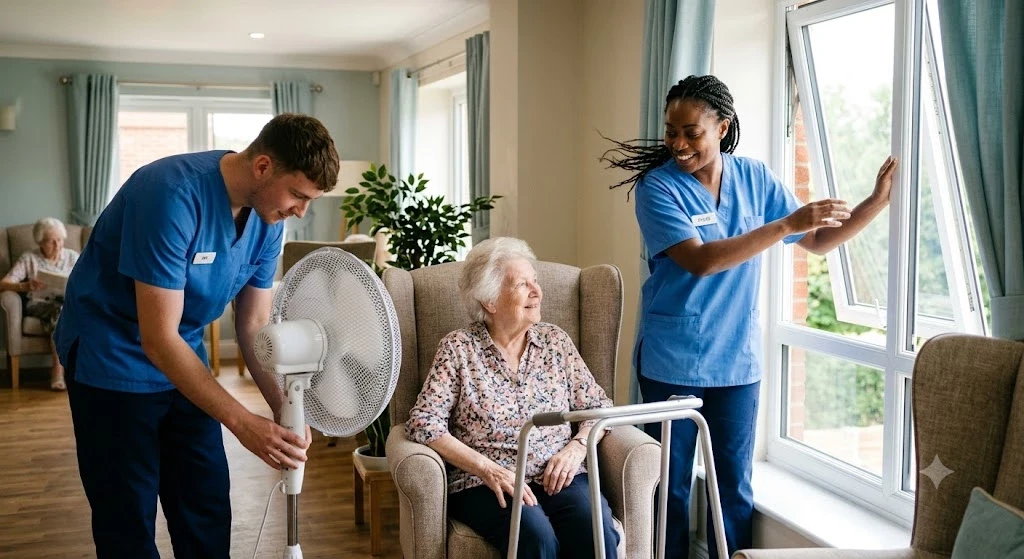
Why Heatwaves Are a Clinical Risk, Not an Inconvenience
Care workers who are to safeguard residents during a heatwave need to understand why heat is genuinely dangerous for the people they support, not just uncomfortable. The NHS guidance on heat exhaustion and heatstroke is clear: heatstroke is a medical emergency. It can kill within hours if not recognised and treated.
The residents most at risk in care settings are:
• People aged 75 and over, whose bodies are less efficient at regulating temperature
• Residents with dementia, who may not recognise or communicate thirst or distress
• Anyone taking diuretics, antipsychotics, antihistamines, or certain blood pressure medications that affect temperature regulation or mask symptoms
• Residents with limited mobility who cannot move to cooler areas independently
• Those with cardiovascular or respiratory conditions that are worsened by heat and dehydration
In 2023, the NHS and UKHSA updated their Adverse Weather and Health Plan, which places specific duties on health and social care providers to prepare for and respond to heat events. Care homes and domiciliary providers are named explicitly.
Understanding the UK Heat-Health Alert System
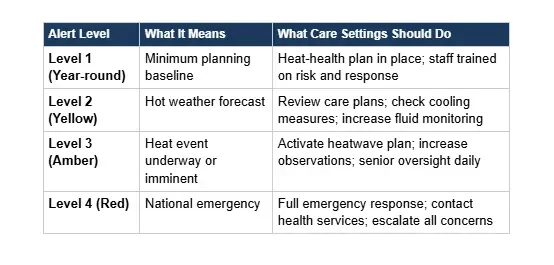
The UKHSA replaced the previous Heatwave Plan with a new Heat-Health Alert system. Every care worker needs to safeguard residents during a heatwave, and knowing which level applies determines what actions are required, not suggested. Below is the table:
Are You Aware
The UKHSA sends Heat-Health Alerts directly to registered care providers during heat events. If your manager has not set up these alerts, they can register with the Heat Alert System. Not receiving them is not an excuse for not knowing.
Practical Steps to Safeguard Residents During a Heatwave
Care Staff are always busy with the usual demands of the shift and somewhere in that routine, a resident who seemed fine at lunchtime is confused, dry-lipped, and not quite right by the time the afternoon round comes. The steps below aid in safeguarding residents:
Step 1: Know Who Is Most At Risk Before the Heat Arrives
Care workers who will safeguard residents during a heatwave need to review care plans before a heat event, not during one. Identify which residents are high risk and flag this to your line manager at the start of any forecast hot spell. If a resident is on medication that affects heat tolerance, this needs to be visible on their care plan and acted on.
Step 2: Hydration; Push It, Document It, Escalate It
Many residents, especially those with dementia, will not self-report thirst. The NHS Eatwell Guide and clinical hydration guidance recommend a minimum of six to eight cups of fluid per day for most adults, especially in the heat. In a heatwave, this is not optional and must be logged.
Practical hydration tips for care workers:
• Offer fluids proactively every hour during a heat event; do not wait to be asked
• Provide a variety: water, diluted squash, iced drinks, soup, yoghurt, and water-rich fruits all count
• Record fluid intake on daily charts. This is both a care standard and a potential evidence trail if a resident deteriorates
• If a resident refuses fluids consistently, escalate to your nurse or manager immediately
Step 3: Environment Cool the Room, Not Just the Resident
The NICE guidance on heatwaves and health recommends keeping sleeping and living areas below 26°C where possible. Actions that care workers can take without waiting for management sign-off include:
• Closing blinds and curtains on windows that face direct sunlight during the day
• Opening windows at night when external temperatures fall below internal ones
• Using fans to circulate air; note that fans do not cool a room above 35°C, they only circulate hot air; other measures are needed alongside
• Applying cool, damp flannels to residents' wrists, neck, and forehead
• Moving residents to the coolest room in the building during peak heat hours (typically 11 am to 3 pm)
Step 4: Recognise Heat-Related Illness
Care workers who will safeguard residents during a heatwave must be confident and quick. The difference between heat exhaustion and heatstroke is the difference between a manageable situation and a 999 call.
Step 5: Documentation: What You Record Protects Everyone
During a heat event, documentation is not a bureaucratic extra; it is clinical evidence. Log temperature observations, fluid intake, any symptoms of heat illness, and any escalations you make. If a resident deteriorates and a safeguarding referral or CQC notification is required later, your records are what managers, regulators, and coroners will look at.
Note: Heatwave risk in care settings tends to be invisible until someone is in crisis. The care workers who catch it early are always the ones who were already watching closely, logging fluid intake, checking on the quiet residents, not assuming that because someone is not complaining, they are fine.
Check This Out!
Certain medications significantly increase heat risk. These include diuretics, ACE inhibitors, beta-blockers, antipsychotics, anticholinergics, and lithium. During a heat event, any resident on these medications should be under closer observation.
Care workers should flag medication lists to the nurse-in-charge or GP during heat events, as some medications may need a temporary dose review. This is not a decision care workers make alone, but recognising the risk and escalating it is absolutely within their role.
Compliance Reminder
Under the CQC's Safe key question, care providers are expected to have plans in place for managing environmental risks, including heat. A heatwave is not an unforeseeable event. If your care home does not have a documented heat-health plan, that gap is a regulatory risk as much as a care risk.
How to Safeguard Residents During a Heatwave in Domiciliary Care
Domiciliary Care workers who safeguard residents during a heatwave face a different set of challenges. You may be working in buildings with no air conditioning, in communities where residents live alone and may not have anyone else checking on them.
Practical actions for domiciliary care workers during a heat event:
• Complete a heat risk check during every visit, check the temperature of the home, the person's skin colour, and ask directly about fluid intake
• If a home is dangerously hot and the person is vulnerable, contact your manager immediately. This may require a safeguarding referral or a welfare check request
• Document what you observed at every visit; a pattern of deteriorating conditions is important clinical evidence
• If the person you visit has no family contact and you are concerned, your duty of care does not end when your visit does; escalate
For domiciliary care workers, a heatwave can mean visiting a resident in a flat that is 38 degrees with the windows closed because they are afraid of intruders. That is not stubbornness; that is vulnerability. Recognising it as a safeguarding issue, not a lifestyle choice, is the difference that training makes.
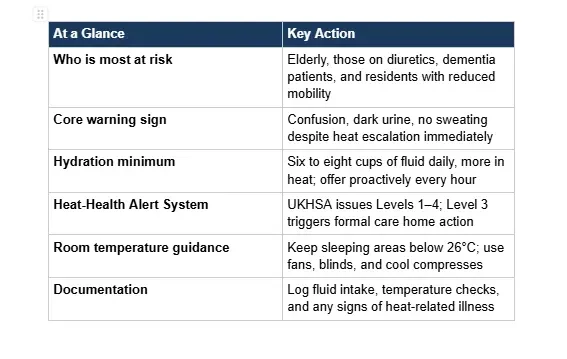
Actionable Tips for Safeguarding Residents During the Heatwave
Keep Your Residents Safe This Heatwave
The hottest years on record keep breaking their own records. Every summer, without fail, the same scenario plays out across care settings in the UK.
The UK's summer heat events are not going away, and the care sector is at the frontline of managing their impact on some of the country's most vulnerable people.
Care workers safeguarding residents during a heatwave do not need to be medical professionals. They need to know who is at risk, what to look for, what to do, and when to escalate. This guide gives you that framework.
Guess what! Training gives you the confidence to use it.
Do not wait for the thermometer to hit 35°C before brushing up on your knowledge. Get trained, get your plan in place, and know exactly what you will do when the heat arrives.
Stay Sharp. Residents Are Counting on It
👉 Download your free care resources and templates
👉 Get 50% off Safeguarding training courses
👉 Join our free monthly expert webinars