Ever had a moment where a resident's meal comes up from the kitchen looking nothing like what was written on their care plan? That gap, between what's prescribed and what actually lands on the plate, is exactly what IDDSI closes.
IDDSI is a globally standardised framework that stands for the International Dysphagia Diet Standardisation Initiative. It's the common language now used across the UK, and much of the world, to describe food textures and drink thicknesses for people with swallowing difficulties, or dysphagia. If you work in a care home, run a domiciliary service, or manage a kitchen team supporting people with dysphagia, IDDSI isn't background knowledge. It's a frontline safety tool.
Before it existed, different care settings and sometimes different professionals within the same setting used their own inconsistent terms like soft diet or thickened fluids with no shared definition of what that actually meant.
That inconsistency was dangerous. A soft diet in one kitchen might be safe for someone; in another, it might be too thick, too thin, or too lumpy for their specific swallowing ability. IDDSI replaced this patchwork of local descriptions with one internationally recognised standard, so that Level 4 pureed means the same thing whether you're in a hospital, a care home, or someone's own kitchen.
In this guide, we'll break down what IDDSI (International Dysphagia Diet Standardisation Initiative) actually is, why it matters so much in adult social care, and what your staff needs to know to keep people safe at mealtimes, from the kitchen right through to the dining table.
Importance of IDDSI in Adult Social Care
Dysphagia is estimated to affect roughly 8% of the world's population, and studies suggest it may affect up to 70% of care home residents. IDDSI exists because inconsistent terminology across care settings was directly contributing to unsafe care.
A person's IDDSI (International Dysphagia Diet Standardisation Initiative) level is a clinical decision, not something care or kitchen staff should decide independently. It's based on a comprehensive assessment, usually carried out by a speech and language therapist (SALT), often working alongside a dietitian where nutrition is also a concern.
Good working relationships with SALT and other professionals should include:
- Referring promptly when a new swallowing concern is identified, rather than waiting to see if it resolves on its own.
- Following written recommendations exactly, including positioning, pacing and alertness guidance, not just the texture level itself.
- Feeding back to the SALT team if a recommendation isn't working in practice, rather than quietly adjusting it yourselves.
- Keeping SALT documentation accessible to the whole staff team, not filed away and forgotten after the initial assessment.
Getting a person's texture or thickness wrong isn't a minor mistake. Food or drink that's too thin for someone's swallowing ability can enter the airway, causing choking or aspiration pneumonia. Food that's unnecessarily restricted, on the other hand, can affect someone's nutrition, hydration, dignity and enjoyment of meals.
Understanding the IDDSI Levels
The IDDSI (International Dysphagia Diet Standardisation Initiative) framework covers 8 levels, numbered 0 to 7. Each IDDSI level has a number, a name, and specific characteristics that determine how it should look, flow and behave.
Drinks are measured across Levels 0 to 4, and foods are measured across Levels 3 to 7, meaning Levels 3 and 4 can apply to either.
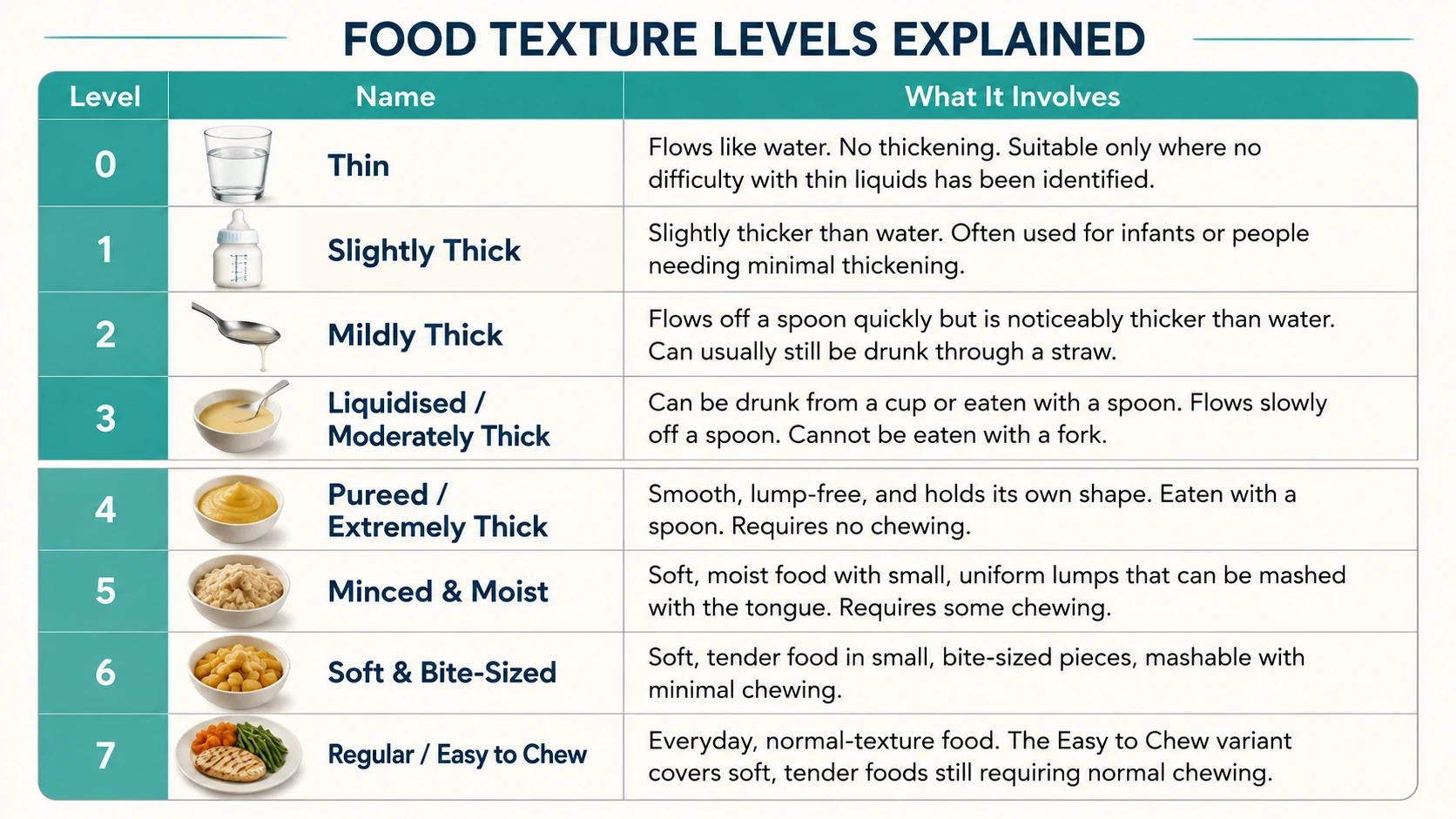
Each level also has an official colour code, which is worth using consistently on care plans, kitchen diet sheets and handover boards so texture requirements are instantly recognisable at a glance.
It's worth remembering that a person may have a different level for food than for drink. Someone might safely manage Level 6 soft, bite-sized food but need Level 2 mildly thick drinks, or vice versa. Never assume the two levels match just because they sit close together on the framework; always check both are recorded and followed separately.
To ensure consistency, IDDSI (International Dysphagia Diet Standardisation Initiative) uses practical, objective testing methods:
- For drinks: The IDDSI flow test uses a syringe to measure how much liquid flows through in a set time.
- For food: Tests like the fork drip test and the spoon tilt test check whether the food holds together and moves the way its level requires.
This matters because texture can't always be judged accurately by eye. Two purees can look almost identical but behave completely differently once someone tries to swallow them. Testing removes the guesswork and gives kitchen and care staff an objective way to confirm they've got it right before food reaches the table.
Role of Care Staff in IDDSI
Care staff don't need to be dysphagia specialists, but they do need a solid working understanding of a few key principles.
The following principles must be considered:
- Following the person's care plan: The IDDSI level recorded in someone's care plan is the level they must be served at, every time, without exception. It should be written clearly by number and name, for example Level 6 – Soft & Bite-Sized, not a vague term like soft food.
- Preparing food correctly: Kitchen teams need to understand how to modify food to reach the correct level consistently, not just on a good day. This includes understanding that mixing different consistencies, like stirring soup into a main course, can accidentally change the texture.
- Following prescribed drink thickness: The same discipline applies to drinks. A person prescribed Level 2 shouldn't be given Level 0 as a treat, and thickener should always be mixed to the manufacturer's and IDDSI (International Dysphagia Diet Standardisation Initiative) guidance, not by eye.
- Avoiding assumptions: Never assume a texture is correct because it looks about right. If in doubt, test it, or ask a colleague who has been trained to test it.
- Knowing when to escalate concerns: If someone coughs, splutters, or shows any new difficulty eating or drinking, this needs to be reported and escalated promptly, not treated as a one-off.
Are You Aware?
Research observing real mealtimes has found that even where kitchens got the base texture right, small departures crept in, like mixing thin soup into a pureed meal, or giving someone Level 0 fluids when Level 1 or 2 was recommended. Small deviations like this are exactly what puts people at risk.
Common IDDSI Mistakes to Avoid
Serving someone the wrong IDDSI (International Dysphagia Diet Standardisation Initiative) level is a safety incident, not a dietary preference issue. Any mismatch between what's prescribed and what's served should be recorded and treated with the same seriousness as any other safeguarding or safety concern.
Even services that are aware of IDDSI can fall into habits that quietly undermine its safety benefits. Watch out for:
- Still using outdated, pre-IDDSI language like soft diet or thickened fluids with no specific level attached.
- Judging texture by appearance instead of testing it properly.
- Inconsistent levels recorded between the care plan, the kitchen diet sheet and the handover book.
- Staff who haven't been trained to understand, test or prepare IDDSI (International Dysphagia Diet Standardisation Initiative) levels correctly.
- Slow or missing updates to records after a swallowing reassessment.
- Treating a coughing or choking episode as a one-off, rather than reporting and reviewing it.

Support Your Residents in Safe Eating and Drinking
IDDSI (International Dysphagia Diet Standardisation Initiative) isn't just a labelling system; it's what keeps people safe.
Get the levels understood, tested and recorded properly, and you'll meet one of the clearest expectations CQC has around nutrition and hydration.
Need more CQC-compliant support?
👉 Download our free Care-Compliant Guides and Templates
👉 Invest in CQC-compliant Adult Social Care Training
👉 Post and apply for care sector job listings over on Care Wizard