LGBTQ+ inclusion shouldn’t be seen as something special or only for a particular kind of service. It should be part of everyday care. The truth is, LGBTQ+ people are more likely to experience mental health challenges, so this matters in real life, not just theory.
When someone walks into a care setting, they don’t leave their identity at the door. They bring their whole life with them, their experiences, their community, the way they’ve had to survive and be understood over time.
For many LGBTQ+ people, that journey has meant having to explain themselves or hide parts of who they are just to feel safe. So in care, it has to be different. People deserve care that is respectful, safe, and accepting, no conditions, no judgment.
A common experience by many LGBTQ+ people in care settings emerged during a peer group discussion for registered managers:
"One of our longer-term residents told me he had stopped mentioning his husband in conversation with staff because he felt uncomfortable. " ~ Marcus Alderton (Registered Manager, Bristol)
A care environment that is not affirming of LGBTQ+ identity can directly worsen mental health outcomes for service users who are already vulnerable.
The responsibility to ensure LGBTQ+ inclusion in care rests with every provider, every registered manager, and every member of the care team. It is both a legal obligation and a moral one.
This guide sets out the practical steps to create genuinely inclusive care environments for LGBTQ+ service users across the UK.

Why LGBTQ+ Inclusion in Care Matters
LGBTQ+ inclusion in care is not optional. The Equality Act 2010 protects people from discrimination on the grounds of sexual orientation and gender reassignment. These are legally protected characteristics, and care providers who fail to uphold them are exposed to enforcement action, regulatory findings, and legal challenges.
CQC's inspection framework explicitly assesses whether services are caring, responsive, and person-centred. Inspectors look for evidence that providers understand and meet the needs of diverse groups. A service that cannot demonstrate how it supports LGBTQ+ service users may find this reflected in its Well-Led and Caring ratings.
Research from Stonewall and Age UK has consistently documented the experience of older LGBTQ+ people in care settings. Their data found that more than one in eight LGBT people (13%) have experienced some form of unequal treatment from healthcare staff because they’re LGBT. It is a systemic gap in how the sector understands and meets the needs of a significant part of its current and future service user population.
For transgender and non-binary service users, the risks are amplified. Misgendering, incorrect pronoun use, lack of appropriate facilities, and staff uncertainty around personal care can cause significant harm and distress.
What Does LGBTQ+ Inclusion in Care Actually Mean?
LGBTQ+ inclusion in care goes well beyond tolerance or non-discrimination. It means actively creating conditions in which lesbian, gay, bisexual, transgender, queer, and other gender and sexually diverse people can access, and experience care fully and without penalty.
In practice, it includes:
• Using correct names, pronouns, and titles consistently and without making it a source of difficulty or comment
• Updating care plans, records, and systems to reflect a person's legal and lived identity
• Providing personal care in a way that respects a person's gender identity, including for transgender service users
• Ensuring that LGBTQ+ service users can speak openly about their relationships, families, and identities without fear of reaction
• Addressing discriminatory comments or behaviours from staff, volunteers, and other service users promptly and clearly
• Reviewing all service communications, displays, and materials for assumptions about heterosexuality or binary gender
It also means recognising that many LGBTQ+ people, particularly those over 65 who grew up during periods of criminalisation and social stigma, may not feel safe to disclose their identity. The role of the care team is to create an environment in which disclosure feels possible, not to require it.
Proactive Steps to Ensure LGBTQ+ Inclusion in Care Settings
LGBTQ+ Inclusion in Care is about building a service culture, environment, and practice where every person, regardless of sexual orientation or gender identity, can receive care without fear, without concealment, and without compromise. Following these steps provides a structured approach to embedding genuine LGBTQ+ inclusion across your service.
Step 1: Review and Update Your Equality and Diversity Policy
Your equality and diversity policy must explicitly name sexual orientation and gender identity as protected characteristics and set out clearly how your service upholds the rights of LGBTQ+ service users. A generic equality statement that does not name these characteristics is insufficient.
Review the policy for specific language around:
• Use of preferred names and pronouns
• How the service handles disclosures of LGBTQ+ identity
• How complaints of discrimination or homophobic and transphobic incidents will be investigated
• Staff conduct expectations in relation to LGBTQ+ service users and colleagues
Ensure the policy is accessible in plain language and is communicated clearly to all staff at induction and annually.
Step 2: Train All Staff in LGBTQ+ Awareness and Inclusive Language
LGBTQ+ awareness training is not a tick-box exercise. It is a practical preparation for real interactions that happen in care settings every day. Training should cover the language of sexual orientation and gender identity, common misconceptions, the history of LGBTQ+ rights in the UK, and how to handle disclosures with confidence and warmth.
Staff should also understand what not to do, such as asking invasive questions, making assumptions about relationships, or treating LGBTQ+ identity as surprising or unusual.
Step 3: Update Care Plans to Reflect LGBTQ+ Identity and Needs
A care plan that does not reflect who a person is cannot fully meet their needs. For LGBTQ+ service users, care plans should include:
• Preferred name, pronouns, and title, separately from legal name if different
• Information about the person's partner or spouse and how they should be treated during visits
• Relevant health considerations, including gender-affirming healthcare needs for transgender service users
• Social preferences and any sensitivities around discussing identity in group settings
This information should be treated with the same confidentiality as any other personal care information and shared with staff on a need-to-know basis in line with GDPR and the person's own preferences.
Step 4: Create a Visibly Welcoming Environment
A welcoming environment communicates inclusion before a word is spoken. This includes:
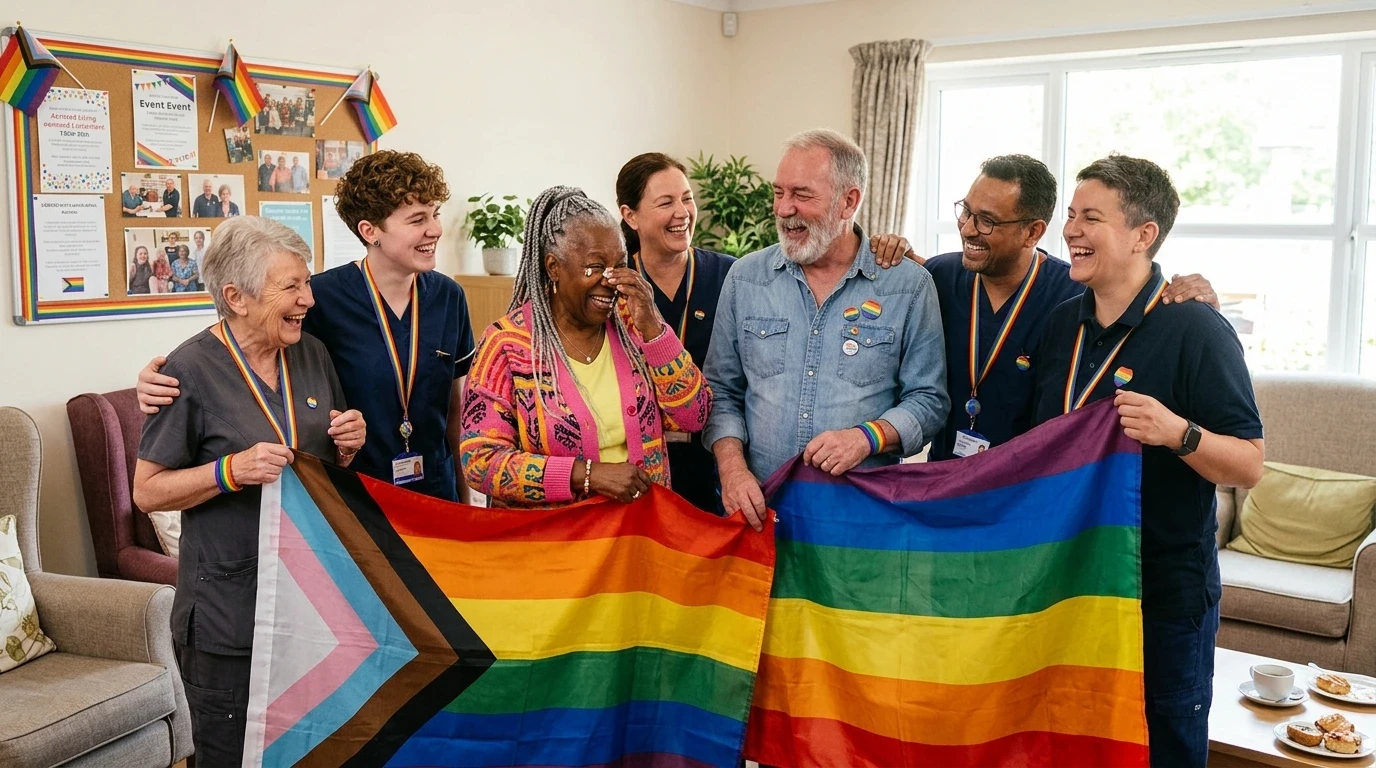
• LGBTQ+ inclusive materials in public areas, such as leaflets, displays, and notice boards that reflect diversity
• Clear signage indicating your service's commitment to equality
• Gender-neutral toilet facilities where feasible
• Single-room policies that allow transgender service users appropriate privacy during personal care
Visibility matters not just for current service users but for those considering whether to disclose their identity. A care environment that looks like it belongs to everyone makes disclosure feel safer.
Step 5: Address Discrimination and Microaggressions Promptly
Discriminatory comments, assumptions, or behaviours, whether from staff, other service users, or visitors, must never be allowed to pass without response. LGBTQ+ service users who witness homophobic or transphobic comments going unchallenged will draw the obvious conclusion about how safe their environment is.
This does not mean creating conflict. It means calmly and clearly addressing what was said and following up with the individuals involved. It also means ensuring your complaints and incidents process specifically addresses LGBTQ+ discrimination, with clear investigation pathways.
The Gender Recognition Act 2004 and the Equality Act 2010 together establish clear obligations for providers to take reasonable steps to prevent third-party harassment of their service users, not just direct discrimination by staff.
Step 6: Engage With LGBTQ+ Organisations and Resources
Building relationships with LGBTQ+ organisations strengthens your service's ability to meet needs you may not have previously encountered. Specialist services for older LGBTQ+ people, national charity networks, and peer support organisations are all valuable resources.
Step 7: Monitor and Review LGBTQ+ Inclusion Actively
LGBTQ+ inclusion should be reviewed as part of your service's ongoing quality monitoring. This includes:
• Asking for feedback from service users about their experience of inclusion, anonymously where preferred
• Reviewing whether LGBTQ+ service users are represented in care planning decisions and reviews
• Checking that staff training is current and that new staff receive induction content on LGBTQ+ inclusive care
• Reviewing incidents and complaints for patterns that may indicate systemic gaps.
Build a Care Setting Where Everyone Belongs
LGBTQ+ inclusion in care is not about adding a pride flag to a notice board or ticking a box on an equality form.
It is at the heart of what person-centred care means. The Equality Act demands it. CQC inspects it, and most importantly, the people in your care deserve it.
Maxwell Keith, a registered manager of a residential care home, reflected on what changed after their team completed LGBTQ+ inclusion training:
"We had not realised how much of our day-to-day language assumed people were heterosexual or cisgender. Once staff became more aware, the conversations with service users opened up. People started telling us things about their lives that they had never shared before."
Building an inclusive service is an ongoing process, not a destination. But every step in the right direction matters to the people in your care.
Start building a more inclusive care environment today.