For 12 years, a single test determined whether a person in a care home or hospital was being deprived of their liberty. Was the person under continuous supervision and control? Were they free to leave?
If the answer to both was yes and no, respectively, that was it, DoLS applied, an authorisation was needed, and the volume of applications that followed was, by anyone's measure, staggering.
In 2024/25, there were 364,900 DoLS authorisation requests in England, an increase of 9.8% on the previous year. Of these, 118,000 applications were not completed within a year.
On 2 June 2026, the UK Supreme Court Ruling on DoLS changed all of that. In a landmark judgment, the Court ruled that the Cheshire West acid test, the legal framework that had defined deprivation of liberty in care since 2014, was wrong. Not imperfect. Not in need of tweaking. Wrong.
The ruling applies with immediate effect across the UK. And that means care workers and providers do not have the luxury of waiting for the full government guidance to land before starting to adjust their practice.
”This judgment is seismic. The redefinition of deprivation of liberty will, over time, reduce the number of DoLS applications, but it also raises serious questions about how we protect people who cannot speak up for themselves." - (Rashpal Bishop, Vice President, Association of Directors of Adult Social Services)
This guide breaks down exactly what the 2026 Supreme Court Ruling on DoLS changed, what it means on the ground for care workers and registered managers, and what your service needs to do right now.
Why did the Supreme Court Ruling on DoLS Change?
The Cheshire West acid test came from the 2014 Supreme Court Ruling on DoLS judgment in P v Cheshire West and Chester Council [2014] UKSC 19. It established a simple two-part test for whether a person was being deprived of their liberty under Article 5 of the European Convention on Human Rights: were they under continuous supervision and control, and were they free to leave?
Crucially, the 2014 judgment concluded that none of the following mattered to that question: whether the care was appropriate, whether the person seemed settled and happy, whether the family had agreed to the placement, or whether the person had ever tried to leave. If the two conditions were met, a deprivation of liberty existed, and an authorisation was required. Full stop. The result was a system under extraordinary strain.
The 2026 Supreme Court Ruling on DoLS ruled that the Cheshire West judgment was wrong for six reasons, but the core of it comes down to this: the acid test was too blunt. It treated every person who lacked mental capacity as automatically unable to consent to their care arrangements, regardless of whether they had any awareness of those arrangements or any ability to express a view about them.
And it ignored context entirely, the type of restrictions in place, the purpose behind them, and the person's own experience of their situation.
The Court recognised that deprivation of liberty cannot be determined by a single legal threshold alone. Instead, every case should be assessed on its own facts, taking into account the person's individual circumstances and the reality of their care arrangements.

Key Changes Introduced by the Supreme Court Ruling on DoLS
The following is the 2026 Supreme Court Ruling on the DoLS, which fundamentally changed the legal framework for assessing deprivation of liberty.
Scraped the Cheshire West Acid Test
For over a decade, the "acid test" from the 2014 P v Cheshire West judgment defined deprivation of liberty as continuous supervision and control with no freedom to leave. This threshold was absolute; factors like the appropriateness of care, the person’s happiness, or their lack of objection were legally irrelevant. If the two conditions were met, a deprivation of liberty existed, and authorisation was mandatory.
The Supreme Court Ruling on DoLS 2026 has fundamentally overturned this approach, declaring it "wrong" and inconsistent with established jurisprudence. The Supreme Court Ruling on DoLS recognised that this "one-size-fits-all" model captured many people who did not actually require the safeguards the system was designed to provide.
Assessment is Now Multifactorial
The Supreme Court rule on DoLS (2026 replaces the "acid test" with a multifactorial assessment. Assessments must now focus on the individual's specific situation, as no single factor is determinative. Key considerations now include:
- Context of Restrictions: The type, duration, and manner of restrictions (e.g., locked doors, physical control, or medication) and how far they deviate from normal life.
- Individual Experience: Whether the person is distressed or content, and how the restrictions impact their daily life.
- Purpose and Proportionality: Restrictions imposed for care and protection are assessed differently from those that are coercive or punitive.
For care workers, this changes the questions you need to be asking:
• Not: Is this person compliant with their care routines?
• But: How do we actually know what this person understands about their situation and how they feel about it?
Compliance is not the same as consent. A person who does not resist care may be doing so because they are sedated, institutionalised, afraid of consequences, or simply do not want to be a burden, none of which constitutes valid consent under the new framework.
Lack of Capacity No Longer Equals Lack of Consent
A major shift is the relationship between mental capacity and consent. Previously, it was assumed that a lack of mental capacity under the Mental Capacity Act 2005 (MCA) meant a person could not consent to their care.
The 2026 Supreme Court Ruling on DOL has ruled this incorrect. The new position is that a person may lack legal capacity for complex decisions but still possess the awareness to express whether they accept or are content with their living arrangements. Where an individual expresses such wishes, their feelings carry significant legal weight and can constitute "valid consent".
Objection is a Key Indicator
The new guidance emphasises that objection is now highly relevant to the assessment of deprivation of liberty. Evidence of distress or refusal is central to identifying whether a deprivation exists.
Practitioners must move beyond asking whether a person is merely compliant and instead ask: How do we know what this individual actually understands and wants?. Signs such as attempts to leave, refusal of care, physical rejection, or the use of sedating medication to manage behaviour point strongly toward a deprivation of liberty requiring authorisation.
DoLS Authorisations Need Review
The judgment took effect immediately on 2 June 2026. Providers should review recent and current DoLS referrals to consider whether they are still appropriate in light of this revised approach. While providers should not rush to cancel existing authorisations abruptly, they must begin reviewing cases against the new multifactorial framework as soon as practicable.
Important CQC Clarification
The CQC has confirmed in its statement of 8 June 2026 that the definition of 'valid consent' introduced by the 2026 ruling does not apply for the purposes of determining whether a person is consenting to their care and treatment under the MCA 2005. The MCA and Regulation 11 requirements are unchanged.
The new consent framework applies specifically to the question of whether a deprivation of liberty exists, not to decisions about care and treatment more broadly.
Key Changes to the DOLS
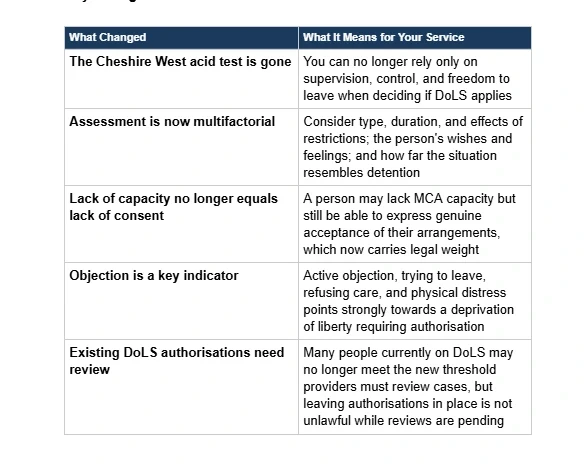
How the Supreme Court Ruling on DoLS Affects Care Professionals
For care workers and providers, these changes are not simply legal updates. They affect everyday practice, from how care plans are reviewed and documented to how staff assess a person's wishes, feelings, and level of objection.
The shift away from the Cheshire West "acid test" means providers can no longer rely on a simple checklist when deciding whether a deprivation of liberty exists. Instead, every assessment must take a broader view of the person's circumstances, considering not only the restrictions placed upon them but also whether those restrictions are necessary, proportionate, and accepted by the individual.
In practical terms, the ruling affects care workers and providers in five key ways:
- Assessing deprivation of liberty differently: Staff must now carry out a broader, person-centred assessment rather than relying solely on the former "acid test."
- Giving greater weight to wishes and feelings: A person's views, behaviour, and level of acceptance or objection must form a central part of every assessment.
- Reviewing existing DoLS authorisations: Providers should reassess current authorisations against the new framework rather than assuming previous decisions remain appropriate.
- Strengthening documentation: Care records should clearly explain why any restrictions are necessary, proportionate, and the least restrictive option available.
- Supporting ongoing compliance: Providers should ensure staff receive updated training and regularly review care arrangements to demonstrate compliance with the new legal framework.
Handling Supreme Ruling Changes as a Care Provider
The CQC statement published 8 June 2026 confirms that the ruling has immediate effect and that providers need to familiarise themselves with this legal development and adjust their practice accordingly. CQC will adopt a proportionate approach during the transition period, but that is not a signal to do nothing.
Here is what your service needs to action:
• Share the ruling with your whole team. The government guidance is explicit: providers must share the ruling or an accurate summary throughout their organisations. Every registered manager, care worker, and relevant agency or bank staff member needs to know the acid test is gone.
• Begin reviewing existing DoLS authorisations. Prioritise cases approaching their end date and cases where the person appears settled and content. Review against the new multifactorial framework, not the acid test.
• Update your policies and protocols. DoLS assessment tools, consent documentation, staff guidance, and any public-facing leaflets that reference the Cheshire West acid test need to be updated to reflect the new legal position.
• Train your staff. NHS England will publish an updated DoLS e-learning module by 30 July 2026. Ensure all relevant staff complete it. In the meantime, registered managers should brief their teams on the key changes.
• Refer borderline cases. If there is any doubt about whether a person's arrangements constitute a deprivation of liberty under the new framework, refer to the local authority supervisory body. Do not leave it unresolved.
• Get legal advice where needed. CQC has confirmed that providers may need to obtain legal advice on specific cases while official guidance is pending. For complex or high-risk cases, this is the right step to take.
During this transition period, organisations should focus on consistency. Managers should ensure staff understand the new legal framework, update internal policies and documentation, and seek advice whenever uncertainty arises. A well-documented, person-centred approach will help services remain compliant while delivering high-quality care.

Prepare Your Team for the Latest DoLS Changes
The 2026 Supreme Court Ruling on DoLS marks one of the most significant changes to DoLS in more than a decade. The acid test gave the sector a simple answer to a complicated question.
The 2026 ruling acknowledges that the question was never that simple to begin with. What it asks of care workers and providers in return is more demanding: genuine attention to the individual, documented reasoning, and a willingness to refer when in doubt.
That is not an impossible standard. It is person-centred care applied to one of the most important legal protections in adult social care. And right now, getting it right matters more than ever.
Get Your Team DoLS Ready for the 2026 Changes
👉 Explore the Level 3 Certificate in Mental Health
👉 Download free DoLS-Compliant resources
👉 Join our free monthly expert webinars
👉 Post and find specialist care roles on Care Wizard for free