Ask ten Care Assistants what they earn, and you will likely get ten different answers; most of them shrug and say, "Whatever it says on the payslip." That is exactly what this Care Assistant salary UK guide exists to answer.
In 2026, understanding your market value is no longer a nice-to-have. It is the difference between accepting the first offer you receive and knowing whether you are being paid fairly for the work you do. With the National Living Wage increasing to £12.71 per hour and employers competing harder than ever to recruit and retain staff, salary conversations have become an important part of building a successful career in care.
The adult social care sector contributes an estimated £77.8 billion to the UK economy every year, yet many Care Assistants still earn close to the legal minimum despite carrying significant responsibility. Pay can vary considerably depending on where you work, the type of employer, whether you work permanent or bank shifts, and the qualifications and experience you bring to the role.
"I had been in the job two years before I found out the agency down the road was paying £15.50 an hour more for the same work. Nobody tells you these things. You just have to know where to look."
Danielle Ashworth, Care Assistant, Leeds
This guide breaks down what a Care Assistant Salary entails across England and Wales in 2026, compares regional pay rates, explains how salaries differ between the private sector and the NHS, and highlights practical ways to increase your earning potential. Whether you are starting your first care role, considering a move to another employer, or preparing to negotiate your next pay review, the information below will help you make informed decisions based on current market data.

The 2026 Care Assistant Salary Benchmarks
Care Assistant roles remain the most in-demand frontline position within adult social care. While individual employers may pay above or below the market average, advertised vacancies reveal a surprisingly consistent pattern across England and Wales.
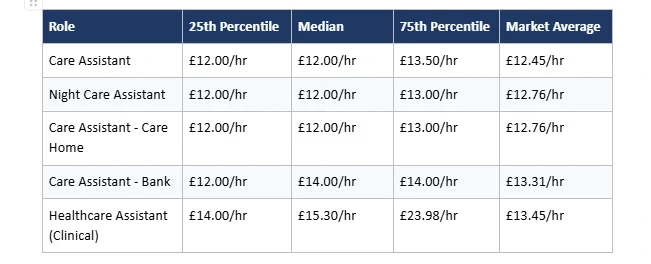
Here is what the market is actually paying, based on the 25th percentile, median, and 75th percentile of advertised rates:
What That Looks Like Annually (Full-Time, 37.5 hrs/week)
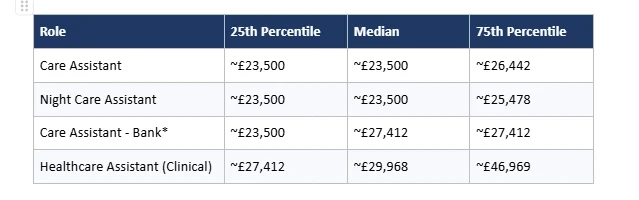
What the Care Assistant Salary Data Tells Us
These are Several important trends that emerge from the latest salary data:
- Most Care Assistant roles remain clustered around the National Living Wage, meaning many providers continue to compete primarily on compliance rather than offering significantly higher salaries.
- Flexibility continues to attract higher hourly rates. Bank Care Assistants generally earn more per hour than permanent colleagues because providers are willing to pay a premium for workers who can fill rota gaps and respond to short-notice staffing needs.
- Additional responsibilities continue to command higher pay. Healthcare Assistants with clinical delegation skills or specialist training typically earn considerably more than standard Care Assistants, demonstrating that professional development remains one of the most effective ways to increase earning potential without leaving the sector.
Note
The salary figures also reinforce an important point: experience alone does not always lead to higher pay. Increasingly, employers reward additional qualifications, delegated clinical skills, and flexibility alongside years of service.
For Care Assistants looking to progress, investing in recognised care qualification training can often deliver a greater financial return than simply remaining in the same role for longer.
Comparing Care Assistant Salaries Across the UK
Although the National Living Wage sets the legal minimum, where you work can have a significant impact on what you actually earn. Local labour shortages, cost of living, competition between providers, and demand for experienced Care Assistants all influence pay rates across the UK.
The salary ranges below highlight how advertised pay varies across major regions and cities.
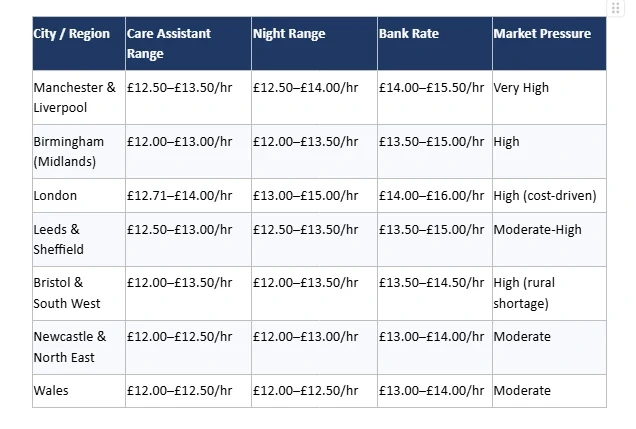
What the Regional Care Assistant Salary Data Shows
Regional salary differences are influenced by far more than geography alone. Here's why:
- London consistently advertises some of the highest hourly rates, reflecting the capital's higher living costs and intense competition for frontline care staff. However, a higher hourly rate does not always translate into higher disposable income once housing, transport, and day-to-day living expenses are taken into account.
- Cities such as Manchester, Liverpool, Bristol, and parts of the South West also continue to advertise competitive salaries, driven by ongoing recruitment challenges and workforce shortages. Meanwhile, some regions in the North East and Wales remain closer to the National Living Wage, although lower living costs may partially offset the difference.
When comparing job offers, consider the complete package rather than focusing solely on hourly pay. Guaranteed hours, travel pay, funded qualifications, and career progression opportunities can significantly increase the overall value of a role.
Are You Aware
For London Care Assistants, the Living Wage Foundation recommends a London Living Wage of £13.85 per hour for 2026. While many employers are moving towards this benchmark, not all providers currently meet it.
If you work in London and your salary falls below the recommended Living Wage, it may be worth discussing a pay review with your employer or comparing opportunities offered by other providers.
Night and Bank Shifts Care Assistant Salary: Which Pays More
Many people assume that working nights automatically leads to significantly higher earnings. In reality, the latest salary data tells a more mixed story.
Night Care Assistants continue to carry considerable responsibility, often working with fewer colleagues while supporting residents with complex needs. Yet advertised salaries show that the traditional night-shift premium has declined considerably in many parts of the country.
Bank work presents a different picture. Providers frequently pay higher hourly rates to attract flexible staff who can cover short-notice absences and busy periods.
Many people assume that working nights automatically leads to significantly higher earnings. In reality, the latest salary data tells a more mixed story.
Night Care Assistants continue to carry considerable responsibility, often working with fewer colleagues while supporting residents with complex needs. Yet advertised salaries show that the traditional night shift premium has reduced considerably in many parts of the country.
Bank work presents a different picture. Providers frequently pay higher hourly rates to attract flexible staff who can cover short-notice absences and busy periods.
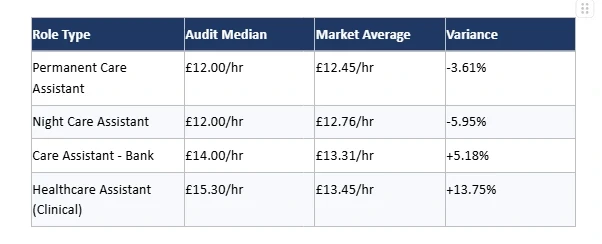
Bank or Permanent Employment: Which Is Right for You?
Higher hourly pay is attractive, but it should never be the only factor when comparing jobs.
Bank work may suit you if you:
- Prefer flexible working patterns.
- Want to supplement another income.
- Are comfortable without guaranteed weekly hours.
- Value higher hourly rates over long-term benefits.
Permanent employment may be the better option if you:
- Want predictable income each month.
- Value paid annual leave and sick pay.
- Wish to build long-term career progression.
- Benefit from pension contributions and funded training.
The best choice depends on your personal circumstances. For some Care Assistants, flexibility is worth more than guaranteed hours. For others, long-term stability provides greater financial security despite a slightly lower hourly rate.
Guess What!
The highest advertised hourly rate is not always the best career move. A role offering funded qualifications, guaranteed hours, career progression, and a supportive working environment may provide greater long-term value than a slightly higher hourly wage with fewer benefits.
Benefits Attached to A Care Assistant Salary
Your hourly rate is only one part of your overall reward package. In today's competitive care sector, many providers are using additional benefits to attract and retain experienced staff. These benefits can make a significant difference to your financial wellbeing, career progression, and work-life balance.
When comparing job offers, don't just ask, "How much does it pay?" Ask, "What does the whole package include?"
Quality employers increasingly offer:
- Guaranteed hours contracts: Greater financial security through predictable income and more stable rotas.
- Early pay access: Schemes such as Wagestream or FlexEarn allow staff to access earned wages before payday without relying on high-interest borrowing.
- Travel pay: Particularly important in domiciliary care, where paid travel time and mileage allowances can substantially increase overall earnings.
- Funded qualifications: Many employers now fully fund Level 2 and Level 3 Diplomas in Adult Care, with some also supporting Level 5 qualifications for future leaders.
- Joining and referral bonuses: Bonuses can provide an immediate financial boost while rewarding employees who recommend new colleagues.
- Employee benefits: Blue Light Cards, free meals, employee assistance programmes, enhanced family leave, wellbeing support, and recognition schemes all contribute to the overall value of an employer's offer.
How You Can Increase Your Care Assistant Salary
Although pay has increased across the sector, qualifications and additional responsibilities remain some of the most effective ways to increase earning potential.
Many employers now actively encourage Care Assistants to develop specialist skills because these not only improve the quality of care but also help address workforce shortages in more advanced roles. Here's what you must know:
Training Opens the Door to Higher Pay
Completing recognised qualifications such as the Level 2 or Level 3 Diploma in Adult Care can strengthen your position when negotiating a pay review and prepare you for more senior roles
Career progression doesn't have to mean leaving care. Many professionals increase their earnings by moving into roles such as:
- Senior Care Assistant
- Healthcare Assistant
- Team Leader
- Care Coordinator
- Deputy Manager
- Registered Manager
Salary Progression Is a Long-Term Investment
The latest salary data suggests that qualifications and specialist skills often have a greater impact on earning potential than years of service alone. Investing in your professional development today can increase both your immediate salary and your long-term career opportunities.
Before accepting a new position, consider asking:
- What is the hourly rate, and are there enhanced rates for nights, weekends, or bank holidays?
- Are travel time and mileage paid if I work in the community?
- Is overtime available, and how is it paid?
- Are there guaranteed hours, or is the role based on a zero-hours contract?
- Will the employer fund recognised qualifications such as a Level 2 or Level 3 Diploma?
- What opportunities are available for career progression?
The answers to these questions can often have a greater impact on your annual earnings than the advertised hourly rate alone.
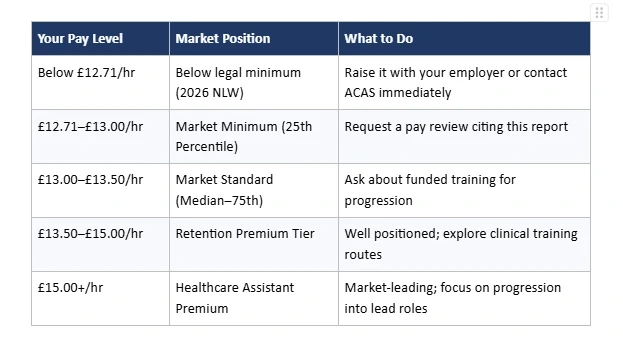
THE 60-Second Digest
If you only remember five things from this guide, make them these:
- Know the current market rate before accepting or negotiating a job offer.
- Compare the whole employment package, not just the hourly rate.
- Regional demand and workforce shortages can significantly influence salaries.
- Bank work may pay more per hour, but permanent roles often provide greater financial security.
- Qualifications and specialist training remain one of the fastest routes to higher pay.
Advance Your Career as a Care Assistant
The more informed you are, the better placed you'll be to recognise employers who value your skills, invest in your development, and offer genuine progression opportunities.
Know Your Worth. The Market Already Does.
👉 Compare live Care Assistant salaries and vacancies on Care Wizard